
How Sweepstakes Casinos Work: Mechanics & Currencies
 Available in US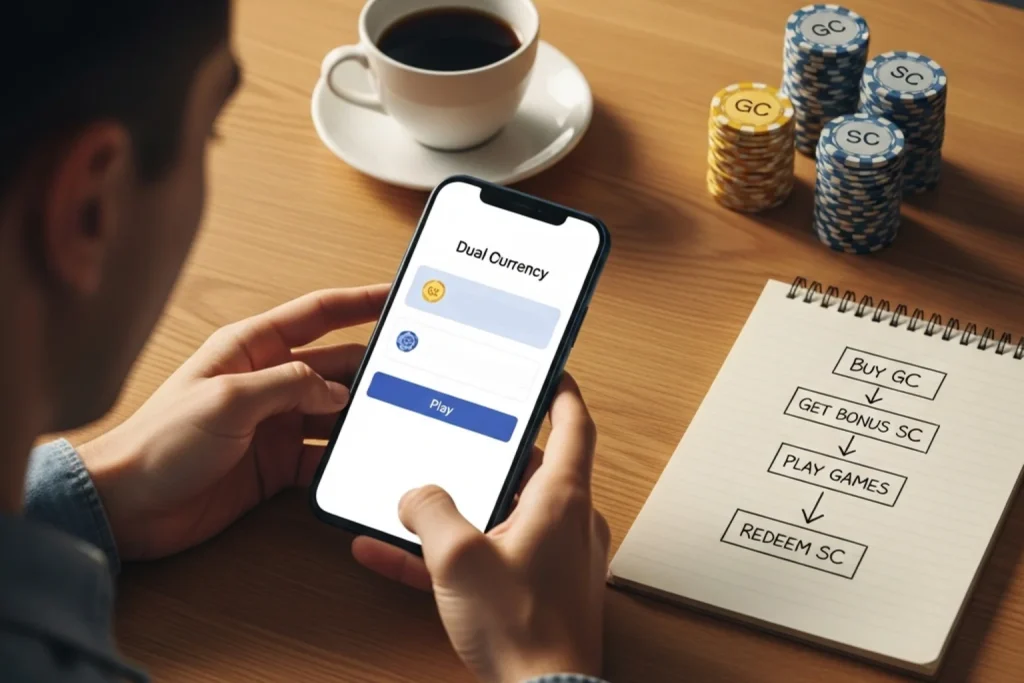
Sweepstakes casinos run on a promotional model that sidesteps the legal definition of gambling by removing one critical element — consideration, the requirement that players pay for a chance to win. That technical distinction has turned into a multi-billion-dollar industry growing at a pace traditional gaming operators find alarming. According to a Gaming Innovation Group investor presentation, the total addressable market for sweepstakes platforms has been expanding at a compound annual growth rate of 31%, climbing from $3.1 billion in 2022 to $6.9 billion by 2026.
The mechanics behind this growth are deceptively simple. Players sign up, receive free virtual currency, play casino-style games, and — if they choose — purchase additional currency that comes bundled with a second, redeemable token. No purchase is ever required. That last part is what keeps the whole structure legal in more than 40 states, and it’s also what makes sweepstakes casino mechanics worth understanding in detail.
This guide walks through every stage of the sweepstakes casino player journey: from the moment you create an account to the point where redeemable coins land in your bank account. Along the way, we’ll unpack the dual-currency system, explain why free entry methods like AMOE exist, and break down the redemption process that turns virtual gameplay into tangible prizes. If you’ve ever wondered how a platform can offer casino games without technically being a casino, the answer lives in the mechanics.
Sweepstakes Casino Registration and Account Setup Process
Creating a sweepstakes casino account looks a lot like signing up for any other online platform — name, email, password, date of birth. But a few details distinguish the process from standard website registration, and those details matter more than most players realize.
The first gate is age verification. Most sweepstakes casinos require players to be at least 18 years old, though some platforms operating in states with stricter gambling-adjacent regulations set the bar at 21. The platform checks your stated age at signup but doesn’t always run a full identity verification at this stage. That comes later, during the redemption process, when real prizes are on the line.
The second gate is geography. Sweepstakes casinos use geo-blocking technology to restrict access from states where they can’t legally operate. As of 2026, six states have enacted outright bans, and platforms must verify your location to stay compliant. This isn’t a one-time check — your IP address and device location are typically monitored on each login. If you move from a legal state to a banned one, you’ll find yourself locked out mid-session.
Once through the gates, new accounts typically receive a welcome package of free virtual currency. This usually includes a batch of Gold Coins — the non-redeemable play currency — and a smaller allotment of Sweeps Coins, the tokens that can eventually be exchanged for prizes. The size of this welcome bonus varies by platform, but it serves the same strategic purpose everywhere: it puts coins in your hands so you start playing immediately, without spending a cent.
Industry data from Racine County Eye, drawing on industry trend reports, indicates that roughly 58% of sweepstakes casino users fall in the 25-to-44 age range. That demographic skew shapes everything from the signup flow (mobile-first, minimal friction) to the default game selection players see after their first login. The platforms are designed for people who are comfortable with digital wallets and app-based entertainment, and the registration process reflects that — lean, fast, and entirely free.
One thing registration does not involve is a credit check, a deposit requirement, or any financial commitment. This isn’t a formality. The absence of a mandatory purchase is the legal foundation of the entire sweepstakes model. You’re entering a promotional sweepstakes, not opening a gambling account, and the signup process is designed to reinforce that distinction at every step.
The Gold Coin Purchase Flow
Gold Coins are the entertainment currency of sweepstakes casinos. You can play games with them, accumulate them, lose them — but you can never redeem them for cash. They exist purely for fun. And yet, Gold Coin purchases are what power the entire industry’s revenue.
Here’s how it works. Platforms offer Gold Coin packages at various price points, typically ranging from $1.99 to $99.99. When you buy a package, you’re purchasing virtual coins for entertainment purposes — essentially the same transaction as buying tokens at an arcade or coins in a mobile game. The purchase is processed through standard payment methods: credit and debit cards, ACH bank transfers, and on some platforms, PayPal or cryptocurrency. Many states treat Gold Coin purchases as taxable sales, meaning you’ll see sales tax applied at checkout, though the specifics vary by jurisdiction.
The purchase itself is unremarkable. What makes it interesting is what comes alongside it. Every Gold Coin package includes a “bonus” of Sweeps Coins — the redeemable currency. A $9.99 package might include 10,000 Gold Coins and 10 Sweeps Coins. The Gold Coins are the product you’re buying. The Sweeps Coins are a promotional bonus attached to that purchase. This bundling is the central mechanic of the entire sweepstakes model.
The distinction sounds like wordplay, and critics argue it essentially is. But from a legal perspective, it’s the reason these platforms can operate. You’re not purchasing a chance to win — you’re purchasing entertainment coins and receiving sweepstakes entries as a free bonus. The promotional framing is deliberate, documented in every platform’s terms of service, and central to how sweepstakes casinos have defended themselves in state legislatures and courtrooms.
Data from the Social and Promotional Gaming Association, drawing on research by Eilers & Krejcik Gaming, shows that the typical purchase among players who do spend money is less than $10. That figure matters because it undercuts the narrative of sweepstakes casinos as high-stakes gambling dens. Most paying players are making purchases comparable to a couple of mobile game upgrades — not wagering their rent money.
Still, the aggregate numbers tell a different story about scale. In 2026, sweepstakes casinos generated approximately $10 billion in Gold Coin package sales, according to Eilers & Krejcik Gaming research conducted for the SGLA. That’s the volume of “entertainment coin” purchases flowing through these platforms annually — a figure that rivals many regulated state gambling markets.
The purchase flow itself is designed for speed and repeat usage. Saved payment methods, one-click purchasing, and prominently displayed “best value” tags on larger packages all encourage regular buying. It’s a conversion funnel optimized by the same principles that drive in-app purchases across the mobile gaming industry, and it’s worth understanding for what it is: a retail transaction with a promotional sweepstakes mechanism attached.
The Sweeps Coins Gameplay Cycle
Once you have Sweeps Coins in your account — whether from a welcome bonus, a Gold Coin purchase bundle, a daily login reward, or an AMOE request — the gameplay cycle begins. And this is where the sweepstakes casino experience starts to look a lot like a traditional online casino, with a few structural differences that matter.
Sweeps Coins are wagered on the same games as Gold Coins: slots, table games, video poker, and in some cases live dealer titles. The interface is usually identical. You toggle between “GC mode” and “SC mode” with a switch, and the game plays exactly the same way. The difference is entirely in what’s at stake. Gold Coins won in gameplay just add to your entertainment balance. Sweeps Coins won in gameplay add to a balance that can eventually be redeemed for cash prizes.
This dual-track design is fundamental to how the model works. Players who never spend a dollar can play indefinitely in GC mode. Players who want to chase real-value outcomes switch to SC mode, where every spin or hand carries redemption potential. An American Gaming Association survey found that 68% of sweepstakes casino players say their primary goal is winning real money. The SC gameplay cycle is what those players are actually engaging with.
A critical detail that many players overlook is the playthrough requirement. Before Sweeps Coins can be redeemed, they typically need to be wagered at least once — sometimes more, depending on the platform and how the coins were obtained. Coins from AMOE or daily logins may carry a 1x playthrough, meaning you need to wager them once before they become redeemable. Coins bundled with Gold Coin purchases sometimes carry the same requirement, though terms vary. This isn’t buried in fine print just to be sneaky; it’s modeled after the playthrough conditions common in regulated online casino bonuses. But it does mean that your Sweeps Coin balance and your redeemable Sweeps Coin balance are not the same number.
The games themselves run on Random Number Generators, supplied by third-party game providers or built in-house by the platform operator. RTP — Return to Player — on individual games typically falls in the 92% to 97% range, comparable to what you’d find at a licensed online casino. But here’s the nuance that trips up a lot of players: game-level RTP and platform-level payout ratio are different metrics. A slot might return 96% of wagers over its lifetime, but that doesn’t mean the platform as a whole returns 96 cents of every dollar spent on Gold Coin packages. The platform’s aggregate payout ratio — the share of revenue returned to players as prizes — sits at 65% to 70%, according to analysis from RG.org. The gap between those two numbers is explained by player behavior: most players don’t wager optimally, many never redeem at all, and the conversion from GC purchases to SC prizes involves multiple steps where value is lost.
The SC gameplay cycle, then, is a loop: acquire coins, wager them on games, meet playthrough requirements, and either reinvest winnings or move them toward redemption. Understanding that loop — and especially understanding the difference between theoretical game returns and actual payout ratios — is essential for any player who takes the “real money” side of sweepstakes casinos seriously.
AMOE and Free Entry: The Legal Backbone
If there’s one mechanism that holds the entire sweepstakes casino model together, it’s AMOE — Alternative Method of Entry. Without it, the whole structure collapses into what most regulators would classify as illegal gambling. That sounds dramatic, but it’s not hyperbole. AMOE is the reason sweepstakes casinos can argue they don’t require “consideration” — the legal term for payment — and therefore don’t meet the three-part test for gambling under U.S. law.
The legal framework goes back decades. Federal sweepstakes law, reinforced by FTC guidelines, requires that any legitimate sweepstakes offer a free method of entry. If you’ve ever seen “NO PURCHASE NECESSARY” on a fast-food cup or magazine subscription mailer, you’ve encountered this principle. Sweepstakes casinos apply the same logic to their entire business model. You can buy Gold Coins and receive Sweeps Coins as a bonus, but you must also be able to obtain Sweeps Coins without buying anything at all. AMOE is that free path.
The most traditional form of AMOE is mail-in entry. Players send a handwritten request — typically a 3×5 index card or a standard letter — to the platform’s mailing address, requesting free Sweeps Coins. The platform processes the request and credits the coins to your account, usually within 7 to 14 business days. The specifics vary: some platforms require specific wording, others accept any legible request. Some limit requests to one per day, per envelope, per household. The details are outlined in each platform’s official sweepstakes rules, and getting them wrong is one of the most common mistakes new players make.
As Magnus Boberg, founder of JustGamblers, explained in a 2026 Yogonet analysis: “Traditional gambling requires three elements: consideration, chance, and prize. Sweepstakes sites do not require payment, so they bypass regulations.” That bypass is AMOE in action. As long as a player can enter the sweepstakes without paying, the “consideration” leg of the legal tripod is removed, and the activity falls under promotional sweepstakes rather than gambling.
Mail-in AMOE isn’t the only free entry channel. Most platforms supplement it with daily login bonuses — small SC allocations awarded simply for opening the app or website each day. Some offer social media promotions, referral bonuses, or periodic free SC giveaways tied to holidays or platform milestones. These all serve the same legal purpose: they demonstrate that players can participate in the sweepstakes without spending money.
The practical reality is more complicated than the legal theory suggests. Mail-in requests cost postage and time. Daily login bonuses are typically small — a fraction of a Sweeps Coin per day. Free entry methods exist and are technically accessible, but the volume of SC they produce is dwarfed by what’s available through Gold Coin purchases. Critics of the model argue that AMOE is a fig leaf: technically compliant but practically marginal. Defenders counter that compliance is what matters legally, and that millions of players do in fact play for free. Data supports the latter claim to some degree — the Social and Promotional Gaming Association reports that approximately 75% of sweepstakes casino users never make a single purchase.
Whether AMOE is a robust consumer protection mechanism or a legal technicality stretched to its limit depends on your perspective. What’s not debatable is its importance to the model. Without a legitimate free entry path, sweepstakes casinos lose their legal distinction from gambling operations. Every platform knows this, which is why AMOE procedures are documented in detail, monitored for compliance, and — for better or worse — the load-bearing wall of the entire industry.
Redemption Mechanics: Turning SC into Prizes
The redemption process is where sweepstakes casinos stop being a game and start involving real money — or, more precisely, real prizes. It’s also where the experience diverges most sharply from free-to-play mobile gaming and starts to resemble something closer to a regulated payout system.
The basic flow is straightforward. Once you’ve accumulated enough redeemable Sweeps Coins — meaning coins that have met their playthrough requirements — you submit a redemption request through the platform. Most sweepstakes casinos convert Sweeps Coins at a rate of approximately 1 SC to $1 USD, though the exact ratio can vary slightly. Minimum redemption thresholds differ by platform: some set the floor at 10 SC ($10), while others require 50 or even 100 SC before you can cash out. These thresholds aren’t arbitrary. They’re calibrated to balance operational costs (processing small payouts isn’t free) against player engagement (setting the bar too high discourages redemption and, by extension, participation).
Before your first redemption, you’ll hit the KYC wall. Know Your Customer verification is triggered when you attempt to convert SC into prizes, and it requires submitting government-issued identification, proof of address, and sometimes additional documentation. The platform needs to confirm your identity, verify you’re of legal age, and ensure you’re located in a state where sweepstakes casinos can legally operate. This process can take anywhere from a few hours to several business days, depending on the platform and how clean your documentation is. Incomplete or mismatched KYC submissions are the single most common reason redemptions get delayed or denied.
Once verified, the actual payout moves through one of several channels. Bank transfers via ACH are the most common method, with processing times typically ranging from 3 to 7 business days. Some platforms offer e-wallet options through services like Skrill or PayPal, which can be faster. A growing number of sweepstakes casinos now support cryptocurrency payouts — Bitcoin and Ethereum being the most common — with processing times that can drop to under 24 hours. The method you choose affects both speed and potential fees, and it’s worth checking the platform’s specific terms before assuming all options are equally convenient.
The scale of these payouts is significant. According to RG.org’s analysis of operator data, sweepstakes platforms return approximately 65% to 70% of total Gold Coin sales revenue to players as Sweeps Coin prizes, with the industry generating a net revenue of roughly $3.4 billion in 2026 after those payouts. That payout ratio reflects the aggregate across all players — including the large majority who never redeem at all. For players who actively pursue redemption, the individual return depends heavily on game selection, wagering patterns, and whether they clear playthrough requirements efficiently.
There are structural limits to keep in mind. Platforms typically impose daily, weekly, or monthly redemption caps. Some require a minimum period between redemption requests. Others restrict certain payout methods to higher-tier or verified accounts. These aren’t necessarily designed to frustrate players — they reflect anti-fraud measures, anti-money-laundering compliance, and the operational reality of processing prize payments at scale. But they do mean that turning a large SC balance into cash isn’t always as instantaneous as the marketing materials might suggest.
The redemption step is also where tax obligations enter the picture. Winnings above $600 trigger a 1099-MISC reporting requirement, and amounts exceeding $5,000 may be subject to 24% federal withholding. We won’t dive deep into tax mechanics here — that’s a separate topic — but players should understand that redemption isn’t just a financial transaction; it’s a taxable event.
Common Pitfalls New Players Hit
Most mistakes players make at sweepstakes casinos aren’t about picking the wrong slot or misreading the odds. They’re procedural — errors in the administrative steps that sit between playing games and actually receiving prizes. Knowing what goes wrong, and where, saves both time and frustration.
Incomplete KYC documentation tops the list. Players breeze through registration, accumulate Sweeps Coins, submit a redemption request — and then discover they need to upload a valid ID, a utility bill with a matching address, and sometimes a selfie for identity confirmation. If the name on your account doesn’t match your government ID exactly, or if your proof of address is outdated, the request gets rejected. Some players create accounts with nicknames or partial names and then hit a wall when KYC demands legal documentation. The fix is simple: use your real, full legal name from the start, and have your documents ready before you ever attempt to redeem.
Ignoring playthrough requirements is almost as common. Not all Sweeps Coins in your balance are immediately redeemable. Coins earned through bonuses, AMOE, or promotional events usually carry a 1x playthrough — meaning you must wager them at least once before they qualify for redemption. Some players see a balance of 100 SC, attempt to redeem, and discover that only 30 SC have cleared the playthrough threshold. The distinction between “SC balance” and “redeemable SC balance” is displayed on most platforms, but it’s easy to miss if you’re not looking for it.
AMOE errors are another frequent stumble. Players who use the mail-in free entry method sometimes forget to follow the precise formatting requirements: wrong envelope size, missing return address, sending multiple requests in a single envelope, or addressing the letter to the wrong department. Each platform publishes specific AMOE instructions in its official sweepstakes rules, and deviations from those instructions can result in denied requests. It’s one of the few areas where attention to administrative detail directly determines whether you receive free coins.
Geo-blocking catches players who travel or relocate. If you created an account in a legal state and then log in from a banned state, your account may be flagged, your gameplay suspended, or your pending redemptions frozen. This applies to temporary travel too — logging in from a hotel in a restricted state can trigger the same response. VPN usage to circumvent geo-blocks violates every platform’s terms of service and can result in permanent account closure and forfeiture of your balance.
Finally, there’s the expectation gap. Players who approach sweepstakes casinos as a money-making venture tend to be the most disappointed. The mechanics are designed around entertainment, with the prize redemption feature as an added layer — not the core product. Understanding that distinction before you start playing is arguably the most important step in the entire player journey.