
Sweepstakes Casino Banned States in 2026: Full List, Laws & Penalties
 Available in US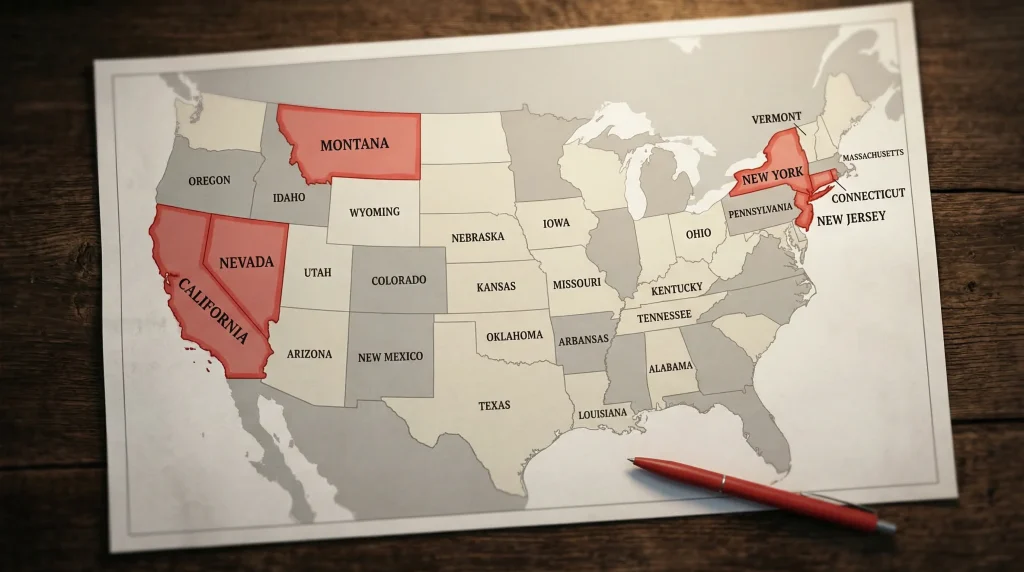
As of 2026, six US states have enacted legislation banning sweepstakes casinos. A seventh — Florida — has a bill in active legislative progress that could expand the list before the year ends. These sweepstakes casino banned states represent some of the largest populations and gambling markets in the country, and their exits have reshaped the industry’s revenue outlook significantly.
This guide provides a quick-reference list of every banned state, the specific legislation behind each ban, the penalties involved, which states are likely next, and why using a VPN to circumvent these bans is a risk that isn’t worth taking.
The Banned States: Full List and Details
According to Gambling Insider’s 2026 market analysis, six states passed sweepstakes casino bans during 2026, all taking effect by early 2026.
California. AB 831, signed by Governor Newsom in October 2026, effective January 1, 2026. The law bans online platforms that sell virtual currency accompanied by a redeemable secondary currency. Penalties include fines up to $25,000 and up to one year in county jail per violation. California represented an estimated 17–20% of total US sweepstakes revenue, making its exit the single largest market loss in the industry’s history.
New York. SB 5935, signed by Governor Hochul on December 5, 2026, effective immediately upon her signature. New York was the second-largest sweepstakes market by revenue, generating an estimated $762 million in GC sales in 2026. Most operators had already exited the state following earlier enforcement actions by Attorney General Letitia James, who sent cease-and-desist letters to 26 platforms before the bill was signed. The law targets the dual-currency model directly, with penalties ranging from $10,000 to $100,000 per violation and potential loss of gaming license eligibility.
Connecticut. Enacted a sweepstakes casino ban as part of broader gambling legislation updates. Connecticut’s regulated gambling market — including Foxwoods and Mohegan Sun tribal casinos — has strong lobbying influence in the state legislature. The ban protects incumbent operators from sweepstakes competition in a small but densely populated state.
Montana. SB 555 banned sweepstakes casinos effective 2026. Montana’s relatively small population makes its market impact minimal compared to California or New York, but the ban signals that even smaller states are taking legislative action against the model.
New Jersey. AB 5447 extended New Jersey’s already strict online gambling regulations to cover sweepstakes casinos. New Jersey has one of the most developed regulated iGaming markets in the US, and sweepstakes platforms were viewed as direct competition to licensed operators paying state licensing fees and taxes.
Nevada. Expanded existing gaming authority powers to include enforcement against sweepstakes casino operations. Nevada’s position as the historical center of US gambling regulation made this move predictable — the Nevada Gaming Control Board has the infrastructure and mandate to protect the state’s regulated gambling industry from unregulated alternatives.
Which States Might Be Next
Florida is the most advanced pending ban. HB 591, an 86-page bill filed in December 2026 that classifies sweepstakes casino operations as a third-degree felony, has been assigned to the House Industries & Professional Activities Subcommittee for the 2026 legislative session starting in March. Florida represents approximately 8.5% of US sweepstakes revenue — another major market that operators could lose in 2026.
Beyond Florida, several states with strong tribal gaming interests or established regulated gambling markets have introduced preliminary sweepstakes-related legislation. States with active tribal compacts — Michigan, Oklahoma, Arizona — have structural incentives to restrict sweepstakes platforms that compete with compact-protected gambling operations.
Industry analysts project continued market contraction. Eilers & Krejcik Gaming’s 2026 forecast sets the baseline at $3.6 billion in net revenue — a 10% decline from the revised 2026 figure. The bear case, which assumes additional state bans, drops to $2.6 billion. The bull case, which assumes no further bans and favorable court rulings, reaches $4.55 billion. The range reflects genuine uncertainty about how many additional states will act.
The pattern across enacted bans follows a consistent template: bipartisan support driven by a coalition of traditional gambling interests, consumer protection advocates, and tribal gaming lobbies. States that have all three of these constituencies active are the most likely to follow the existing six into prohibition.
The legislative pace accelerated dramatically in 2026. Before that year, no state had explicitly banned sweepstakes casinos through dedicated legislation. Within twelve months, six did. The speed suggests a domino dynamic — each enacted ban lowers the political risk for the next state considering similar action. Legislators who may have hesitated in 2026 now have California and New York as precedent, which changes the calculus for fence-sitters in their own statehouses.
Penalties and Enforcement
Penalties for sweepstakes casino violations vary significantly by state — from misdemeanor-level fines to felony charges.
California’s AB 831 imposes fines up to $25,000 per violation and up to one year in county jail. These penalties target operators, not individual players. Florida’s pending HB 591 escalates significantly, classifying operations as a third-degree felony carrying up to five years in prison and a $5,000 fine.
Enforcement actions have moved beyond legislation into litigation. The most prominent case to date is the Los Angeles City Attorney’s lawsuit against Stake.us, filed in August 2026. City Attorney Hydee Feldstein Soto described the platform as “a rogue and real money gambling racket.” The case seeks to establish legal precedent that sweepstakes casinos with redeemable currencies constitute illegal gambling regardless of the AMOE provision.
For players, the direct legal risk in enacted-ban states is currently low — existing legislation targets operators, not users. However, accessing a banned platform from a prohibited state violates the platform’s terms of service, which means your account can be terminated and your SC balance forfeited without recourse. The legal risk is to your money, not your freedom — but the financial consequences are real.
Why VPN Circumvention Isn’t Worth the Risk
The temptation to use a VPN to mask your location and continue playing from a banned state is understandable. The math makes it a bad idea.
Sweepstakes casinos actively detect VPN usage. They cross-reference your IP address against your registered account address, your KYC documents, and your payment method billing address. A VPN might fool the initial geo-check, but the discrepancy surfaces during any withdrawal attempt or account review. The result is almost always account suspension and balance forfeiture — you lose everything you’ve accumulated, with no dispute mechanism.
Beyond platform enforcement, VPN usage to access banned gambling services could theoretically expose you to legal liability under state law. While no individual player has been prosecuted to date for VPN-based sweepstakes access, the expanding legal framework means this remains an evolving risk area. The precedent doesn’t exist yet — which means there’s also no precedent protecting you.
The rational approach for players in banned states: withdraw your existing SC balance before the ban’s effective date. Close your accounts cleanly. Monitor legislative developments for any reversal or amendment. And if you relocate to a non-banned state, you can register fresh with full legal standing. Circumvention adds risk without adding any reliable upside.
For players in states where sweepstakes casinos are still legal, keep an eye on your state legislature. The six bans that passed in 2026 moved fast — several went from committee to signed law in a matter of months. If your state introduces a sweepstakes ban bill, the window for redeeming your SC balance and closing your accounts may be shorter than you expect. Proactive awareness is the best protection against being caught on the wrong side of a new law with an unredeemed balance.