
AMOE Sweepstakes Casino: Free Sweeps Coins by Mail
 Available in US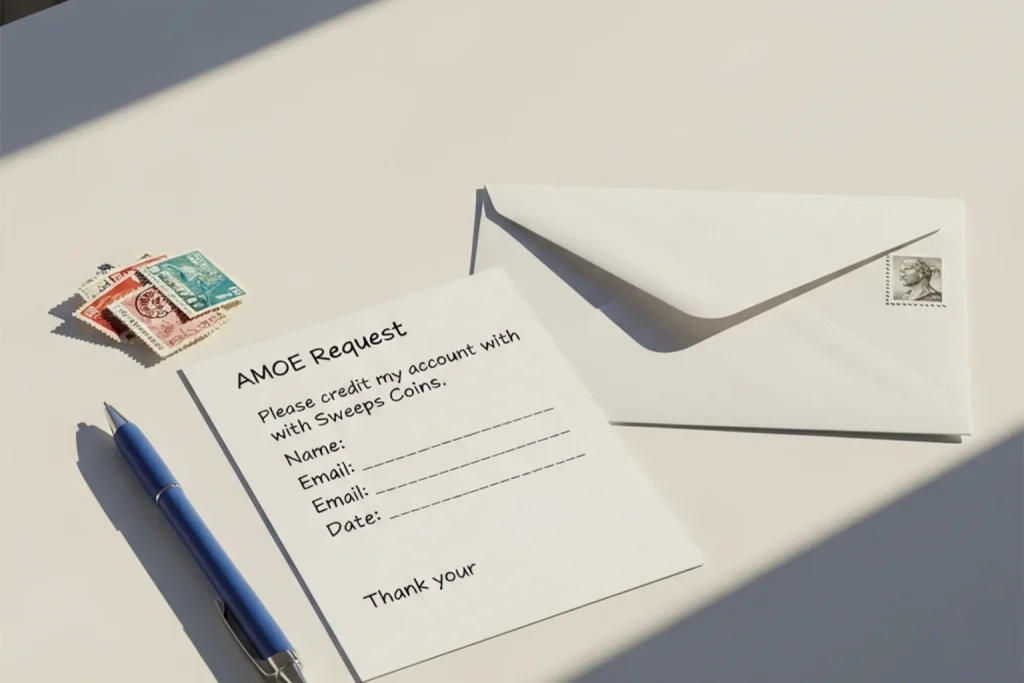
Most players have heard of AMOE. Very few use it. The process feels anachronistic — writing a physical letter in 2026 to request digital tokens — and platforms don’t exactly advertise it on their homepage. But the legal significance of AMOE is enormous, and for players willing to invest a few minutes and a postage stamp, it offers one of the best effort-to-value ratios among all free SC methods.
This guide covers why AMOE exists in the first place, exactly how to write and send a valid request, how different platforms handle the process, and whether the economics actually make sense for you.
AMOE Explained: The Legal Basis for Free Sweeps Coins by Mail
Gambling in the United States is defined by three elements: consideration (something of value risked), chance, and prize. Remove any one of those three, and the activity no longer qualifies as gambling under most state and federal definitions. Sweepstakes casinos target the first element — consideration — by ensuring that players can always participate without making a purchase.
AMOE is the mechanism that makes this possible. By offering a free entry method, platforms can argue that no consideration is required to receive Sweeps Coins. You can play the sweepstakes, compete for prizes, and redeem winnings without ever spending a dollar. The GC purchase option exists as a parallel path, but the AMOE route ensures the entire system is legally structured as a promotional sweepstakes rather than a gambling service.
This isn’t a theoretical distinction. It’s the operational foundation of a market that has generated staggering revenue. According to SPGA data based on Eilers & Krejcik Gaming research, Americans have spent over $40 billion on social casino currency over the past decade — a figure that only exists because the sweepstakes model, anchored by AMOE, has been accepted as legally distinct from gambling in the majority of US states.
Federal sweepstakes law — reinforced by FTC guidelines and state-level consumer protection statutes — requires that any legitimate sweepstakes provide a free entry method that offers the same prize opportunity as the paid entry. AMOE fulfills this requirement. When you send a mail-in request, the SC you receive carries the same playthrough conditions and the same redemption potential as SC obtained through a GC purchase. There’s no second-class version of the currency.
The Unlawful Internet Gambling Enforcement Act of 2006 (UIGEA) further shapes the landscape. UIGEA targets financial transactions related to unlawful internet gambling but explicitly exempts activities that qualify as sweepstakes or contests. AMOE is the linchpin that keeps sweepstakes casinos within that exemption. Without it, the legal shield evaporates — which is exactly why the six states that have banned sweepstakes casinos focused their legislation on redefining these platforms as gambling operations regardless of the AMOE provision.
For players, the practical takeaway is this: if a sweepstakes casino doesn’t offer AMOE, its legal status is questionable. AMOE isn’t a nice-to-have feature. It’s a structural requirement.
How to Send an AMOE Request: Step by Step
The process is deliberately low-tech. Platforms specify physical mail as the AMOE channel partly because it creates a natural friction that prevents mass-automated abuse, and partly because physical sweepstakes mail-in entries have legal precedent stretching back decades.
Step 1: Find the platform’s AMOE address and instructions. This information is typically buried in the Terms of Service or a dedicated “Sweepstakes Rules” page. Don’t guess — each platform has specific formatting requirements, and requests that don’t follow them may be rejected or ignored. The mailing address, required statement, and any additional details (like your username or account number) vary by operator.
Step 2: Handwrite your request. Most platforms require a handwritten letter — not typed, not printed. On a standard piece of paper or a 3×5 index card (platform-dependent), write the specified request statement. A typical format reads something like: “I wish to receive Sweeps Coins to participate in the promotional sweepstakes at [Platform Name]. My username is [your username].” Include your full legal name, registered email address, and mailing address.
Step 3: Address the envelope. Use a standard #10 business envelope. Write the platform’s AMOE address clearly on the front. Include your return address — some platforms reject requests without one. Do not include any payment, as that would defeat the purpose and could invalidate your request.
Step 4: Mail it. A standard first-class USPS stamp is sufficient. As of 2026, that’s $0.78 per letter. There’s no benefit to priority mail or certified delivery unless you want tracking for personal records. The letter will arrive in 3–7 business days depending on distance.
Step 5: Wait for processing. After the platform receives your letter, processing typically takes 7–14 business days. The SC is credited directly to the account associated with the username you provided. You won’t receive a physical reply — the reward appears in your account balance. Some platforms send an email notification; others credit the SC silently.
Step 6: Verify receipt. Log in and check your SC balance. If the expected amount hasn’t appeared after two weeks, contact customer support with the date you mailed your request and your tracking information (if applicable). Delays happen, especially during high-volume periods.
One critical rule: most platforms limit AMOE to one request per day, per household, per envelope. Sending five letters in the same envelope doesn’t yield five times the reward — it typically yields nothing, because the request doesn’t comply with the stated rules.
AMOE Policies by Platform
AMOE rules differ across platforms in ways that affect both the effort required and the reward received. Here’s how major operators handle it.
Chumba Casino accepts one AMOE request per day and credits 5 SC per valid letter. The request must include your Chumba username, legal name, email, and mailing address on a handwritten card. Processing takes 7–10 business days. Chumba’s AMOE program is well-documented and has been operational since the platform’s early years.
Stake.us offers AMOE with similar terms: one request daily, 5 SC per letter. The format requires a handwritten note on a 3×5 index card inside a standard envelope. Stake.us has a slightly faster processing turnaround — some users report credits appearing within 5–7 business days — though this varies.
WOW Vegas follows the standard one-per-day model but awards 5 SC plus a batch of Gold Coins per valid request. The formatting requirements mirror the industry norm: handwritten, with account details and return address included.
Pulsz has been less consistent with AMOE documentation. The program exists — as it legally must — but the instructions have historically been harder to locate on the site, and some users report longer processing times compared to competitors.
Across the industry, AMOE is used by a small fraction of the player base. According to RG.org, only about 12% of sweepstakes casino players ever make a purchase — meaning 88% play for free. Within that free-player majority, AMOE users represent a subset who’ve gone beyond passive login bonuses to actively request SC through the mail. The exact participation rate isn’t publicly disclosed, but platform-level data suggests it remains in the low single digits of total accounts.
Is AMOE Worth the Effort?
The math is straightforward. A first-class stamp costs $0.78. A standard envelope and index card add a few cents. Round the total material cost to roughly $0.85 per request. In return, you receive 5 SC, which carries approximately $5 in potential redemption value. That’s roughly a 6:1 return ratio before accounting for the time investment.
The time cost is modest but not negligible. Writing the request, addressing the envelope, and mailing it takes about 5–10 minutes per letter. If you batch-prepare a week’s worth of AMOE requests in one sitting — pre-writing the cards, pre-addressing the envelopes — the per-letter time drops significantly. Twenty minutes of prep on a Sunday can produce five ready-to-mail requests for the week.
Over a month, one daily AMOE request across a single platform yields approximately 150 SC ($150 in potential prize value) for about $24 in postage and maybe two hours of total effort. Across two platforms, that doubles. The economics are compelling for anyone willing to maintain the routine.
Where AMOE makes less sense: if your time has a high opportunity cost and you’re comfortable spending small amounts on GC packages, the purchase route delivers SC instantly without the delay and manual effort. AMOE is optimized for players who either can’t or prefer not to spend money, and who treat the process as a low-stakes routine rather than a chore.
The bottom line is that AMOE occupies an unusual position — it’s simultaneously the legal cornerstone of the entire sweepstakes industry and one of the least utilized features by actual players. For those who take it seriously, the returns are difficult to match through any other free method.