
Sweepstakes Casino KYC Verification Process
 Available in US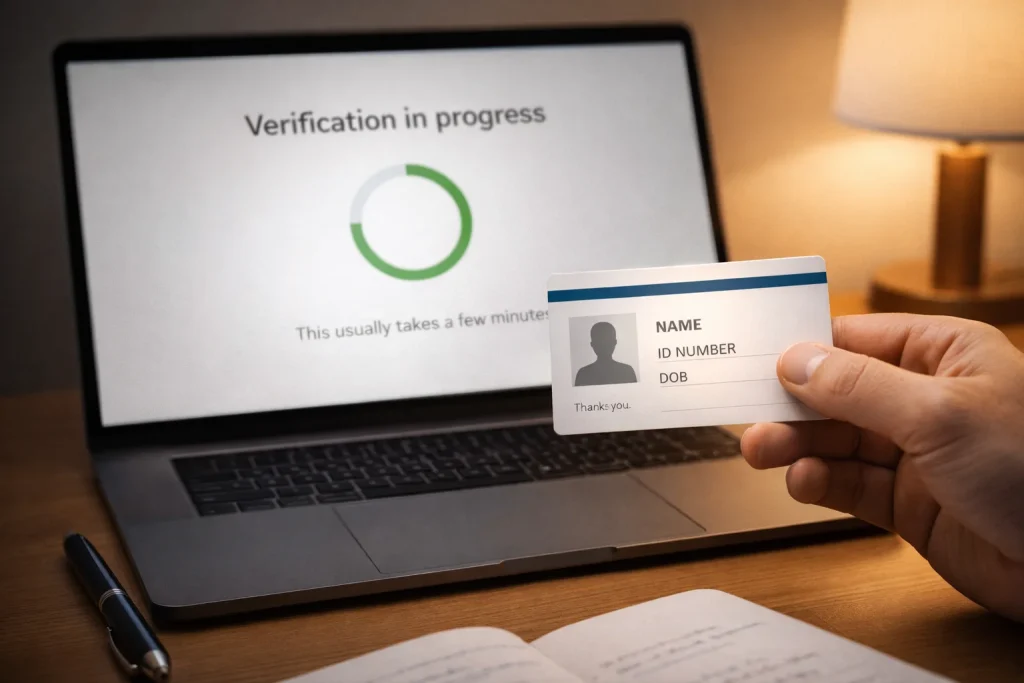
This guide walks through what documents you’ll need, how the process works on mobile and desktop, the most common reasons verifications get rejected, and what happens to your personal data after it’s submitted.
Keep in mind that verification requirements may vary depending on your location, so always verify the US sweepstakes casino legal states before submitting your documents.
Required Documents for Sweepstakes Casino KYC Verification
Every platform asks for the same core documents, though the exact combination and format requirements vary. Here’s what to have ready before you initiate the process.
Government-issued photo ID. This is non-negotiable. Acceptable forms include a US driver’s license, state-issued ID card, or passport. The document must be current — expired IDs are universally rejected. Both the front and back of the ID are typically required for driver’s licenses and state IDs. For passports, the photo and signature pages are sufficient.
Proof of address. Platforms need to verify that your residential address matches the information on your account. Accepted documents include a recent utility bill (gas, electric, water, internet), a bank or credit card statement, or a government-issued letter (e.g., tax correspondence). The document must show your name and address clearly and usually must be dated within the last 90 days. Screenshots of online statements are accepted by some platforms but not all — check before you submit.
Social Security Number (partial). A subset of platforms requests the last four digits of your SSN. This is tied to federal tax reporting requirements: when your total redeemed prizes exceed $600 in a calendar year, the platform issues a 1099-MISC to both you and the IRS. Providing SSN digits at the KYC stage enables that reporting without requiring a second verification later.
The verification requirement underscores how these platforms operate in practice. According to a 2026 AGA survey of 2,250 respondents, 90% of sweepstakes casino players consider the activity to be gambling — 59% said “definitely” and 31% said “probably.” The KYC process reinforces that perception: it mirrors what regulated gambling sites require, and for good reason. The financial flows, even within a promotional sweepstakes model, carry real compliance obligations.
Selfie verification. Increasingly common, especially for first-time redemptions above certain thresholds. The platform asks you to take a live photo of yourself holding your ID, or uses facial recognition technology to match your face against your submitted document. This adds a layer of fraud prevention that static document uploads alone can’t provide.
The Verification Process
KYC verification at sweepstakes casinos follows one of two models: automated or manual. Understanding which your platform uses helps set realistic expectations for turnaround time.
Automated verification uses OCR (optical character recognition) and database cross-referencing to validate your documents in near real-time. You upload your ID and proof of address, the system extracts the text, checks it against public databases, and either approves or flags the submission. When it works, verification completes in minutes. When the system can’t read your document — poor lighting, glare, low resolution — it escalates to manual review.
Manual verification involves a human reviewer examining your documents. This is the fallback for flagged automated submissions and the default at some smaller platforms that haven’t invested in OCR infrastructure. Manual reviews typically take 24–72 hours during business days, though weekends and holidays can extend the timeline. Some platforms batch manual reviews, processing them once or twice daily rather than on a rolling basis.
On mobile, the process is camera-driven. You’ll photograph your ID using your phone’s camera within the platform’s app or browser interface. Good lighting, a flat surface, and a steady hand make the difference between a first-attempt approval and a rejection that sends you back to square one. Desktop submissions accept uploaded image files — JPG, PNG, or PDF — which gives you more control over image quality.
A growing number of platforms now offer proactive KYC — the option to verify your identity immediately after registration, before you’ve accumulated any SC to redeem. This is the approach experienced players recommend. Completing KYC early means there’s no delay when you’re ready to cash out. Waiting until your first redemption attempt to start verification adds days to an already multi-step process.
Verification status is typically displayed in your account settings. Look for labels like “Verified,” “Pending,” or “Action Required.” If your status shows pending for more than five business days without communication from the platform, contact support with your submission date and ticket reference.
Common Rejection Reasons and How to Avoid Them
KYC rejections aren’t random. The same issues account for the vast majority of failed verifications, and every one of them is preventable.
Blurry or obscured documents. The number-one rejection trigger. Photos taken in poor lighting, at an angle, or with fingers partially covering the document will fail automated scans and frustrate manual reviewers. Use natural light, place the document on a dark, flat surface, and shoot straight down. Ensure all four corners of the document are visible and no text is cut off.
Expired identification. An expired driver’s license or passport is rejected universally. If your ID expires within weeks and you’re planning a KYC submission, consider waiting for the renewal — or submit your passport if it has a later expiration date.
Name mismatch. The name on your ID must match the name on your sweepstakes casino account exactly. If you registered with a nickname, abbreviation, or maiden name that differs from your legal identification, you’ll need to update your account information before resubmitting. Some platforms allow name-change requests through support; others require a new account, which forfeits your existing balance.
Address mismatch. Your proof of address must correspond to the residential address on your account. If you’ve moved recently and your utility bill shows a different address than your registration, update your account first. Submitting conflicting addresses is a fraud signal that triggers manual review or outright rejection.
Geo-restriction violations. Six states now ban sweepstakes casinos: California, New York, Connecticut, Montana, New Jersey, and Nevada. If your ID shows a residential address in one of these states, KYC verification will be denied — and your account may be restricted regardless of where you’re physically located at the time of submission. VPN usage to mask your location compounds the problem: platforms cross-reference IP data with account information, and discrepancies between your stated address and your connection location are flagged automatically.
Duplicate accounts. If the platform’s database links your identity documents to an existing account — even one you forgot about — the new account’s KYC will be rejected. Sweepstakes casinos enforce one-account-per-person rules strictly, and submitting the same ID on multiple accounts can result in all associated accounts being suspended.
Privacy and Data Protection
Submitting government ID and proof of address to an online platform raises legitimate privacy concerns. Here’s what you should know about how sweepstakes casinos handle your personal data.
Major operators store KYC documents using encryption — both in transit (TLS/SSL) and at rest (AES-256 or equivalent). The data is typically retained for the duration of your account’s existence plus a statutory holding period required by anti-money-laundering regulations. This retention period varies but commonly extends several years beyond account closure.
California residents benefit from CCPA protections, which include the right to know what personal data is collected, the right to request deletion, and the right to opt out of data sale. Players in other states may have fewer formal protections, though most established platforms voluntarily extend privacy practices that approximate CCPA standards across their entire US user base — largely because maintaining separate compliance frameworks by state is more costly than applying a uniform standard.
A few practical precautions: only submit documents through the platform’s official verification interface, never via email. If a support agent asks you to email your ID directly, treat it as a red flag — legitimate platforms route all document submissions through their secure upload systems. Check the platform’s privacy policy for data retention terms, third-party sharing disclosures, and deletion request procedures. And if you close your account, follow up on your right to have your KYC documents removed from the system.
The tension is real: sweepstakes casinos need your identity data to operate legally, but the platforms themselves operate in a regulatory environment with less oversight than traditional financial institutions or licensed gambling operators. Being informed about what you’re sharing and how it’s stored is a reasonable approach to navigating that gap.
For a seamless registration and verification process, choose one of the legal sweepstakes coins casinos that prioritize player security.