
Are Sweepstakes Casinos Legal in 2026? State Laws Guide
 Available in US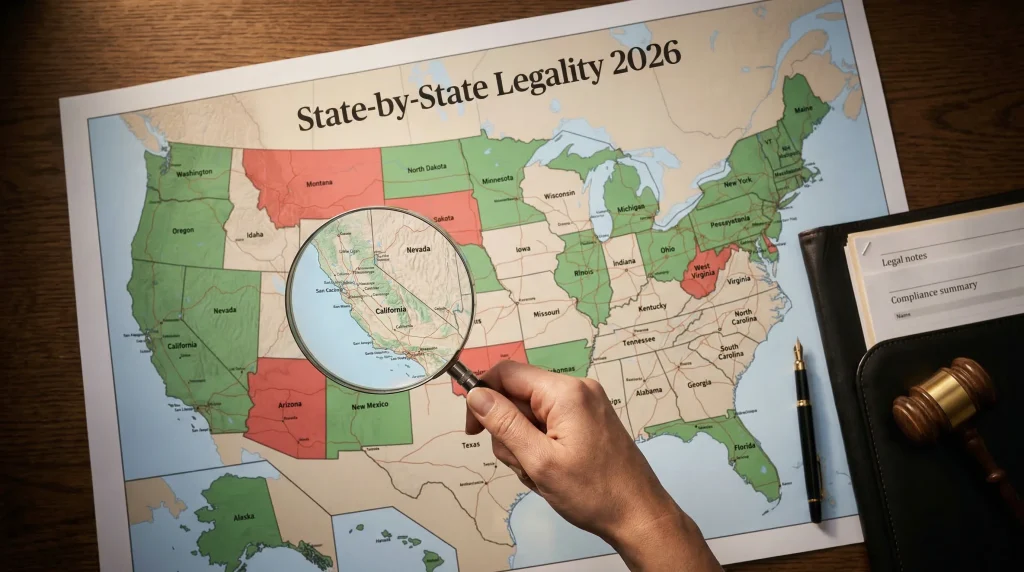
Are sweepstakes casinos legal? The answer in 2026 is: it depends entirely on where you live — and the map is shifting faster than most players realize. In 2026, six states enacted legislative bans targeting sweepstakes casino platforms, the most aggressive regulatory crackdown the industry has faced since its emergence. California, New York, Connecticut, Montana, New Jersey, and Nevada all moved to restrict or prohibit the dual-currency model that sweepstakes casinos use to operate outside traditional gambling law.
The legal argument underpinning sweepstakes casinos is not new. It rests on a straightforward principle: gambling, as defined by most U.S. jurisdictions, requires three elements — consideration (payment), chance, and prize. Sweepstakes casinos claim to eliminate the consideration element by offering free entry methods, which reclassifies their operations as promotional sweepstakes rather than gambling. For years, this argument held. Platforms operated in more than 40 states with minimal regulatory interference. But that era of quiet tolerance appears to be ending.
This article is a legal overview for non-lawyers. It traces the federal framework that allows sweepstakes casinos to exist, maps the states where they currently operate, breaks down every 2026 ban with specifics on fines and enforcement, and looks ahead to the pending bills that could reshape the landscape in 2026. One disclaimer before we begin: this is informational analysis, not legal advice. State laws are complex, evolving, and enforced differently across jurisdictions. If you have questions about your specific situation, consult a licensed attorney in your state.
The Federal Legal Framework for Sweepstakes Casinos in 2026
Understanding why sweepstakes casinos exist requires understanding the gap between federal gambling law and the sweepstakes exemption that these platforms exploit. At the federal level, gambling regulation is primarily governed by three pieces of legislation, none of which were written with online sweepstakes casinos in mind.
The Wire Act of 1961 prohibits the use of wire communications for placing bets or transmitting wagering information across state lines. For decades, this was interpreted broadly as a blanket ban on interstate online gambling. A 2011 Department of Justice opinion narrowed its scope to sports betting, and a subsequent 2019 DOJ opinion attempted to reverse that interpretation — though courts have since limited the broader reading. The key point for sweepstakes casinos: the Wire Act targets “bets or wagers,” and if sweepstakes platforms don’t legally constitute gambling, the Wire Act doesn’t apply to them. That’s the argument, at least.
The Unlawful Internet Gambling Enforcement Act of 2006 (UIGEA) takes a different approach. Rather than defining gambling itself, it targets financial transactions related to unlawful internet gambling, making it illegal for banks and payment processors to handle such transactions. UIGEA explicitly exempts activities that fall under state sweepstakes laws. This exemption is the federal-level anchor for the sweepstakes casino model — if the activity qualifies as a legitimate sweepstakes under state law, UIGEA’s payment restrictions don’t apply.
The Federal Trade Commission also plays a role. The FTC enforces regulations on sweepstakes promotions, requiring that all sweepstakes offer a free method of entry (AMOE), provide clear disclosure of odds and rules, and avoid deceptive marketing. These aren’t gambling-specific regulations — they apply to any promotional sweepstakes, from McDonald’s Monopoly to Publisher’s Clearing House. Sweepstakes casinos operate under the same FTC framework, which is why every platform is required to offer AMOE and publish official sweepstakes rules.
The American Gaming Association has framed the scale of the problem differently. AGA estimated that in 2026, unregulated operators — including sweepstakes casinos — accepted approximately $109 billion in wagers, costing the regulated industry an estimated $17.3 billion in lost revenue. Whether you consider sweepstakes casinos a legitimate use of sweepstakes law or a clever circumvention of gambling regulation often depends on which side of that $17.3 billion you sit on.
The absence of a federal law specifically addressing sweepstakes casinos means the regulatory landscape is fragmented. Each state decides for itself whether these platforms are legal sweepstakes promotions or unlicensed gambling operations. That fragmentation is what produces the patchwork legality map that defines the industry in 2026.
States Where Sweepstakes Casinos Operate
As of early 2026, sweepstakes casinos operate in more than 40 U.S. states. That number sounds reassuring until you examine what “operate” actually means in this context — because legal status and regulatory oversight are not the same thing.
In the vast majority of states where sweepstakes casinos are accessible, they exist in a regulatory gray zone. No state gambling commission has issued them a license. No state regulator audits their games, reviews their payout ratios, or enforces player protection standards. The platforms operate because no law specifically prohibits them — not because any law specifically authorizes them. This distinction between “not illegal” and “regulated” is critical, and it’s the gap that legislators are increasingly trying to close.
The states where sweepstakes casinos face the fewest complications tend to be those with limited online gambling legislation and no pending bills targeting the sweepstakes model. Much of the Midwest, Southeast, and Mountain West falls into this category. Players in states like Texas, Ohio, Pennsylvania, and Illinois can access sweepstakes platforms without legal impediment — though they should be aware that the legislative environment can shift in a single session.
Age requirements add another layer of complexity. Most sweepstakes casinos set the participation age at 18, aligning with the legal age for sweepstakes entry in most jurisdictions. However, some states where traditional gambling is legal at 21 create ambiguity about whether that age floor applies to sweepstakes as well. Platforms generally default to the more conservative threshold in states where the line is unclear, but enforcement is inconsistent.
The player base across these states is substantial. The Social and Promotional Gaming Association estimates that approximately 55 million Americans engage with sweepstakes casino platforms. That figure encompasses free players, occasional purchasers, and regular users — but even with generous definitions, it represents a significant share of the U.S. adult population and explains why the industry’s revenue numbers have scaled so rapidly.
For players in operational states, the practical experience is straightforward: you sign up, verify your location, receive welcome bonuses, and play. But it’s worth repeating that “legal” in this context means “not yet banned.” No state has passed a law affirming the legality of sweepstakes casinos as a regulated product. Players operate under the same legal logic the platforms do — that sweepstakes promotions are inherently permissible under existing law. Whether that interpretation survives the current wave of legislative scrutiny is an open question, and any player who assumes their state will remain accessible indefinitely should keep one eye on their state legislature’s calendar.
States with Bans: The 2026–2026 Wave
The legislative crackdown on sweepstakes casinos didn’t happen overnight, but when it arrived, it came from multiple directions simultaneously. Six states moved against the industry in 2026, each with its own rationale, penalties, and economic impact. Here’s what happened in each.
California: AB 831
California’s ban is the most consequential action any state has taken against sweepstakes casinos. Assembly Bill 831, signed by Governor Newsom in October 2026, prohibits all dual-currency sweepstakes gaming platforms in the state. The law took effect on January 1, 2026, and carries penalties of up to $25,000 in fines and up to one year of imprisonment per violation.
The financial impact on the industry is massive. California represented an estimated 17% to 20% of total U.S. sweepstakes casino revenue, according to Eilers & Krejcik Gaming analysis presented at G2E in October 2026. Losing the state’s player base forced analysts to slash projections across the board.
The bill’s passage was notable for its bipartisan unanimity. Shawn Fluharty, West Virginia Delegate and President of the National Council of Legislators from Gaming States (NCLGS), remarked at G2E 2026 that the sweepstakes industry “couldn’t get one vote in California. You know how hard that is?” — a reference to the state’s notorious political divisions and a measure of how thoroughly the industry had lost legislative support.
The California ban was catalyzed in part by a high-profile lawsuit filed by Los Angeles City Attorney Hydee Feldstein Soto against Stake.us in August 2026, in which she described the platform as a “rogue and real money gambling racket.” While the lawsuit targeted a specific operator, it created momentum for the broader legislative action that followed.
New York: SB 5935
New York’s ban, enacted through Senate Bill 5935, represents the second-largest revenue loss for the industry. According to Eilers & Krejcik Gaming data prepared for the SGLA, New York accounted for approximately $762 million in sweepstakes casino sales in 2026. Governor Hochul signed the ban into law in 2026, effectively shutting sweepstakes platforms out of the nation’s fourth-largest state by population.
New York’s approach reflects its broader position as a state with an established regulated online gambling market. The state legalized mobile sports betting in 2022 and has been deliberating online casino legislation. From Albany’s perspective, sweepstakes casinos represent an unregulated competitor operating alongside — and drawing revenue from — a market the state is actively trying to build and tax.
Connecticut, Montana, New Jersey, and Nevada
The remaining four bans share a common thread: each state already has a regulated gambling infrastructure and viewed sweepstakes casinos as an unauthorized incursion into that market.
Connecticut, home to the Mohegan Sun and Foxwoods tribal casinos and a state-regulated online gaming market, banned sweepstakes platforms to protect its existing gaming compact. Montana passed SB 555, targeting sweepstakes-style operations that had been proliferating in the state’s retail and online spaces. New Jersey, one of the most mature legal online gambling markets in the country, acted to prevent unregulated competition with its licensed operators. Nevada, the historic seat of American gambling regulation, expanded existing enforcement authority to cover the sweepstakes model — a move that surprised no one familiar with the state’s protective stance toward its gaming industry.
Together, these six bans removed a significant share of the U.S. player base from the sweepstakes market. The states aren’t random — they represent some of the largest, wealthiest, and most gambling-active populations in the country. The pattern is clear: states with the most to lose from unregulated competition are the states moving fastest to shut it down.
Pending Legislation and 2026 Outlook
The six bans enacted in 2026 may not be the end. Several additional states have introduced or are considering legislation that would further restrict sweepstakes casino operations, and the industry’s financial forecasts for 2026 reflect the uncertainty.
Florida is the most significant pending case. House Bill 591, an 86-page bill introduced in the Florida legislature, would classify sweepstakes casino operations as a third-degree felony. That’s not a regulatory fine — it’s a criminal charge. If passed, HB 591 would make Florida one of the most aggressive states in the country on sweepstakes enforcement. The stakes are proportionally large: according to SGLA economic analysis, Florida accounts for approximately 8.5% of sweepstakes operator revenue, and the state could generate an estimated $63 million in tax revenue if it chose to regulate rather than ban the industry. That argument — regulate and tax rather than prohibit — has been central to the industry’s lobbying strategy, but it hasn’t gained traction in Tallahassee.
Beyond Florida, several other states have introduced or discussed sweepstakes-related bills, though not all have progressed beyond committee stage. The trajectory of these bills will depend on the same factors driving the 2026 bans: lobbying pressure from regulated gaming operators, tribal gaming interests, and the perceived political risk of appearing soft on unregulated gambling.
Eilers & Krejcik Gaming, the most widely cited analyst firm in the sweepstakes sector, has published three scenarios for 2026 net revenue. The base case projects a 10% decline to $3.6 billion, reflecting the loss of California and New York. The bull case — $4.55 billion — assumes no additional major bans and continued growth in remaining states. The bear case — $2.6 billion — accounts for further state-level bans, including Florida, and a chilling effect on player acquisition. The spread between those scenarios is nearly $2 billion, which gives a sense of how much legislative risk the industry carries heading into the year.
The industry’s organized response has been to double down on advocacy, consolidating its lobbying resources into a single body and pushing legislators to regulate rather than prohibit. Whether that effort succeeds in slowing the legislative momentum will likely define the industry’s shape by the end of 2026.
Industry Self-Regulation: SPGA, SGLA, and the Push for Legitimacy
While legislators have been moving to restrict sweepstakes casinos, the industry has been trying to organize itself into something that looks more like a regulated sector. The two most visible efforts — the Social and Promotional Gaming Association (SPGA) and the Social Gaming Leadership Alliance (SGLA) — represent the industry’s attempt to get ahead of regulation by writing its own rules.
The SPGA was formed in September 2026 by ten sweepstakes casino operators. Its stated mission was to establish industry standards, develop a code of conduct, and create a unified voice for the sector. Within months, SPGA had published a code of conduct covering responsible gaming practices, advertising standards, and player protection measures — essentially a self-regulatory framework designed to demonstrate that the industry could police itself without state intervention.
The SGLA, led by former U.S. congressman Jeff Duncan, took a more politically oriented approach. Duncan’s pitch to legislators has been direct. As he stated at the NCLGS conference in December 2026: “We want to be regulated. We want to pay taxes.” That message — the industry isn’t trying to evade oversight, it’s asking for a regulatory framework it can operate within — represents the SGLA’s core argument against prohibition.
In September 2026, SPGA and SGLA merged into a single organization, consolidating their lobbying resources and policy positions. The merger created a more unified industry front, but it also raised questions about whether an industry body funded by sweepstakes operators can meaningfully regulate the companies that fund it. Self-regulation has a mixed track record across industries, and critics of the sweepstakes model see the SPGA/SGLA structure as more PR than protection.
The opposition is well-organized. The AGA — representing the traditional, regulated gaming industry — has been the most vocal critic of sweepstakes casinos. The NCLGS, a bipartisan group of state legislators with jurisdiction over gaming policy, has aligned closely with the AGA’s position. Their argument is simple: sweepstakes casinos are gambling, they should be regulated like gambling, and self-regulation by the operators themselves is insufficient. NCLGS president Shawn Fluharty put it bluntly at the December 2026 conference: lawmakers across party lines agree that sweepstakes platforms represent illegal gambling operations.
The clash between these positions — industry-led self-regulation versus state-imposed gambling oversight — is the central tension in sweepstakes casino policy in 2026. The outcome in each state will depend on which argument proves more persuasive to local legislators, and the answer is likely to vary widely across jurisdictions.
What Players Should Know
The legal landscape for sweepstakes casinos is moving. If you’re a player — or considering becoming one — here are the practical takeaways from the current environment.
First, check your state’s status before you play, and recheck it periodically. Laws enacted in 2026 went from bill to enforcement in months, not years. California’s AB 831 was signed in October and took effect on January 1, 2026. Players who weren’t paying attention to their state legislature found themselves locked out of platforms they’d been using for years, sometimes with unredeemed balances still in their accounts. Staying informed about pending legislation in your state isn’t paranoia — it’s basic risk management.
Second, understand that “legal” and “regulated” are different things. In the 40-plus states where sweepstakes casinos operate, there is no state gaming commission reviewing the platforms, auditing their RNG systems, or enforcing payout standards. The consumer protections that exist at a licensed online casino — game fairness certification, mandatory payout ratios, dispute resolution through a regulatory body — do not apply to sweepstakes platforms. You’re relying on the operator’s self-imposed standards and the general consumer protection provisions of your state’s commercial law.
Third, know the risks if you’re in or near a ban state. Accessing a sweepstakes casino from a banned state using a VPN violates the platform’s terms of service and could expose you to legal consequences under the state’s new law. The platforms are geo-blocked for a reason, and circumventing those blocks isn’t just a Terms of Service issue — in states like California, it could theoretically trigger criminal penalties.
Fourth, keep records. If you’re in a state where sweepstakes casinos are legal and you’re actively playing, maintain documentation of your purchases, SC balance, and redemption activity. If your state passes a ban, having records of your account status may matter for resolving any pending balances. It also matters for tax purposes, since Sweeps Coin redemptions above $600 are reportable income regardless of your state’s position on the legality of the platform.
The fundamental reality is this: sweepstakes casinos occupy a legal space that is shrinking. The industry isn’t disappearing — it generates billions in revenue and serves tens of millions of players — but the era of operating with minimal regulatory scrutiny in nearly every state is over. Players who understand that context are better positioned to make informed decisions about whether, where, and how they participate.